Why the Porsche 993 Cup 3.8 RSR Has Become One of the World’s Most Collectible Porsche Race Cars
Factory provenance, scarcity and analogue usability explain why informed collectors are looking harder at Porsche Motorsport’s final air-cooled customer racer.
RGB
By
Ralf G. Bahr
Founder · RGB Motors
Published
23 August 2026
Reading time
6 mins
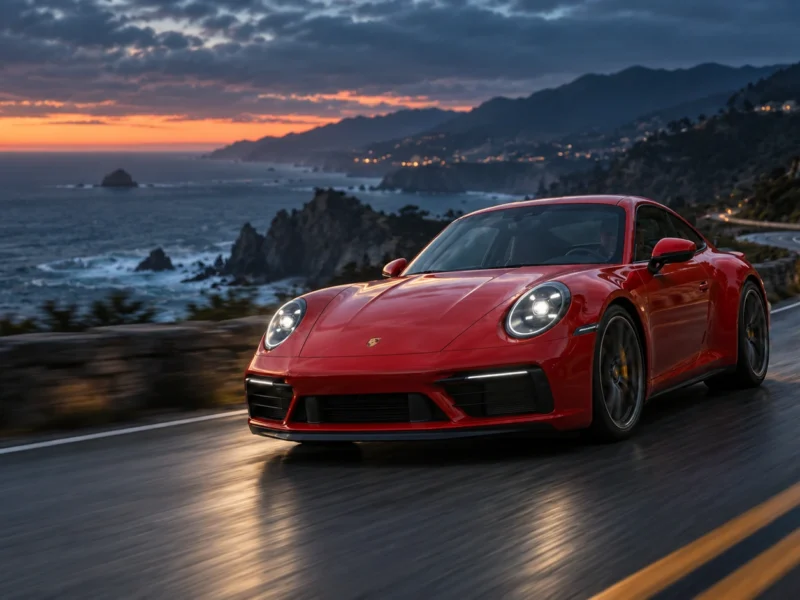
1997 Porsche 911 Cup 3.8 RSR · Factory identity, rarity and analogue usabilityEditorial visual · RGB Motors
In this article
The market for important Porsche competition cars has matured considerably over the past decade. Collectors who once focused primarily on limited-production road cars increasingly recognize that factory-built Porsche Motorsport cars belong to a category of their own. Their rarity, engineering significance, competition purpose and direct connection to Weissach give them a historical authenticity that even the most desirable production Porsche cannot duplicate.
Few cars illustrate this better than the Porsche 993 Cup 3.8 RSR.
The 993 arrived at a pivotal moment in Porsche history. It was the final generation of the air-cooled 911, but for Porsche Motorsport it also laid the groundwork for an increasingly sophisticated generation of customer racing cars. Porsche had spent decades developing competition versions of the 911, from the early 911 S and Carrera RSR through the 934, 935 and later Carrera Cup and RSR programmes. By the mid-1990s, much of that experience was distilled into the 993.
The Cup 3.8 RSR was one of the ultimate expressions of that development.
Built by Porsche Motorsport for competition
The distinction between a genuine RSR and a road-going 993 converted for track use is fundamental to the RSR’s collector significance.
The RSR was conceived and built as a competition car. Its engineering went far beyond removing interior trim and adding racing equipment. Porsche Motorsport developed the chassis, suspension, braking system, aerodynamics and drivetrain as an integrated package for serious GT and endurance competition.
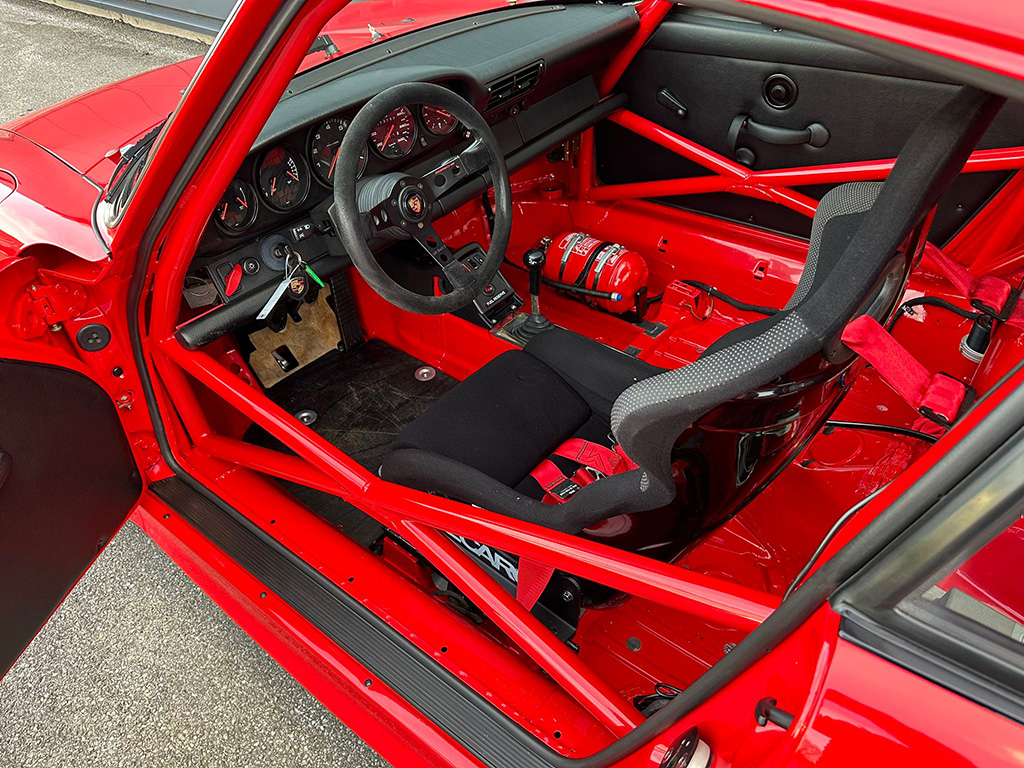
The body incorporated a fully welded roll cage, providing both the safety structure and the additional chassis rigidity required for racing. Weight reduction included an alloy bonnet, while the suspension used competition-oriented ball joints and two-way adjustable Bilstein dampers.
Visually, the RSR’s purpose was unmistakable. GT2-style bolt-on wheel-arch extensions accommodated wider racing wheels and tyres, while the large adjustable rear wing provided aerodynamic balance at competition speeds.
The braking system was equally serious. The endurance specification included massive 380 mm front brakes, reflecting the expectation that these cars would undergo repeated high-speed braking during long-distance events. A driver-adjustable front anti-roll bar allowed chassis balance to be adjusted according to circuit conditions and tyre behaviour.
Even by contemporary standards, this was formidable racing equipment.
The M64/75: the heart of the RSR
At the heart of the package was Porsche’s M64/75 3.8-liter naturally aspirated, air-cooled flat-six.
Rated at approximately 349 horsepower, the engine was a highly developed version of the classic air-cooled Porsche architecture. Porsche Motorsport incorporated stronger, lighter valve-train components, high-lift camshafts, special pistons and cylinders, and revised intake and exhaust systems.
Perhaps most characteristic were the six individual throttle bodies, which gave each cylinder an immediate response to throttle input.
The result was not simply horsepower. It was response, durability and a mechanical character that defined Porsche’s naturally aspirated racing engines of the period.
For today’s collector, that engine has additional significance: it belongs to the closing chapter of factory-developed air-cooled Porsche competition machinery. The water-cooled era was rapidly approaching, making the RSR one of the last opportunities to experience the traditional Porsche racing formula at its highest level of development.
A factory cockpit centred on the driver’s relationship with the machine
Rarity with substance
Rarity is often used too casually in the collector-car world. However, in the case of the 993 RSR, the numbers are genuinely small.
Porsche’s 1997 specification for the “20631 RSR Package Vehicle” resulted in approximately 30 cars in 1997, followed by another 15 in 1998.
That brings total production to approximately 45 examples.
But production numbers alone do not determine the importance, or value, of an individual RSR.
For a serious collector, the questions become more specific: Is it a genuine Porsche Motorsport-built car? Does the chassis match the factory records? Are the original engine and major mechanical components present? Is there documented ownership history? Has the car been heavily modified during its competition life? Are its historical documents, engineering records and maintenance history preserved?
Those questions separate an important competition Porsche from merely an interesting old race car.
The importance of provenance
RGB Motors Reference #137 offers an instructive example.
Finished in Guards Red, the 1997 Cup 3.8 RSR has had only three owners since new and has been under its current ownership since 2017. It has been preserved in private collector ownership rather than subjected to decades of continuous professional competition.
The car shows only 13,308 kilometres (8,269 miles) and retains matching-numbers originality, as documented. Its specification includes the M64/75 3.8-liter engine, factory racing seat, six-point harness and fire-suppression system.
The accompanying documentation and engineering information are especially important. For a competition Porsche, paperwork can be nearly as significant as the physical automobile because it helps establish precisely what the car is and how it fits into the factory racing programme.
What should a collector look for?
Buying an RSR requires a different approach than purchasing even a rare road-going Porsche.
The first priority should always be identity.
Factory records, chassis numbers, engine numbers, build specifications and period documentation should be reconciled. Competition cars often evolve throughout their lives. Engines are rebuilt, gearboxes changed, suspension components replaced and body panels damaged or upgraded. None of that is unusual in motorsport, but it must be understood.
Originality should therefore be considered in context. A perfectly preserved race car may be exceptional, but a documented period modification can also be a legitimate part of its history.
Condition is equally important. A competition engine can look immaculate externally even as it approaches the end of its service life. The same applies to the gearbox, fuel system, dampers, brakes and safety equipment. Specialist inspection and documented maintenance are essential.
Finally, buyers should determine what they want from their car.
For some, an RSR will become the centrepiece of a Porsche Motorsport collection. For others, eligibility for historic racing and the chance to drive the car on a circuit are equally important. The best examples can satisfy both ambitions.
That combination—factory provenance, extremely limited production, extraordinary engineering and genuine usability—explains why the Porsche 993 Cup 3.8 RSR has firmly entered the upper tier of collectible Porsche competition cars.
It is not simply a rare 993. It is a factory-built artefact from the final years of the air-cooled Porsche Motorsport era.
Published 23 August 2026. Market observations reflect the time of writing. For a purchase decision, request the individual car’s current records and an independent inspection.
Request occasional market notes, fresh arrivals and new Driver’s Brief articles. Requests are handled personally by RGB Motors; this is not an automated subscription.