Porsche 993 Cup 3.8 RSR Specifications, History and Collector Guide
The factory specification, historical significance and documentation points that define Porsche Motorsport’s final air-cooled customer racing 911.
The factory specification, historical significance and documentation points that define Porsche Motorsport’s final air-cooled customer racing 911.

Every great racing manufacturer eventually reaches a point when one engineering era gives way to another.
For Porsche, the late 1990s marked one of those defining moments.
For more than three decades, the air-cooled flat-six was at the heart of Porsche’s identity. It powered road cars, Carrera Cup machines, rally cars and some of the most successful GT and endurance racing cars ever built. Through continuous development, Porsche transformed what began as a relatively simple sports-car engine into one of motorsport’s most durable and sophisticated competition powerplants.
The 993 Cup 3.8 RSR stands near the end of that extraordinary development line.
To understand why the RSR matters today, it helps to know where it came from.
Porsche’s customer racing philosophy was established long before the 993 appeared.
The company recognized that private teams were essential to its motorsport success. Rather than limiting serious racing machinery to a works team, Porsche developed competition cars that qualified customers could buy and campaign themselves.
The Carrera RS and RSR programmes of the early 1970s established the formula: reduce weight, increase power, strengthen the chassis and braking system, and provide private competitors with a car capable of winning major events.
That philosophy reached extraordinary heights with the turbocharged 934 and 935, while later generations returned Porsche customer racing to increasingly production-based platforms.
The arrival of the Carrera Cup concept marked another important step. It created tightly controlled racing machinery based on the contemporary 911 and allowed Porsche Motorsport to develop chassis, suspension and drivetrain components under demanding competition conditions.
The 964-generation Carrera Cup and RSR programmes refined that concept considerably.
Then came the 993.
The road-going 993 introduced important advances, but Porsche Motorsport’s RSR package transformed the platform into a far more specialized vehicle.
A full Matter-welded roll cage became an integral part of the competition chassis. The suspension incorporated ball-jointed components and adjustable two-way Bilstein dampers. A driver-adjustable front anti-roll bar gave the driver or engineer another means to tune handling balance during an event.
The RSR’s widened bodywork was functional rather than decorative. GT2-style bolt-on flares provided clearance for competition wheels and tyres, while the adjustable rear wing allowed the aerodynamic setup to be matched to different circuits.
Endurance racing placed enormous demands on braking systems, and Porsche equipped the RSR accordingly, with front brakes measuring up to 380 mm in the endurance specification.
An optional 100-liter Premier safety fuel cell further underscored the car’s intended purpose. This equipment was designed for long-distance competition, not weekend track-day use.
Every component reflected Porsche’s decades of experience making racing 911s fast, durable and serviceable.
The engine remained the centrepiece.
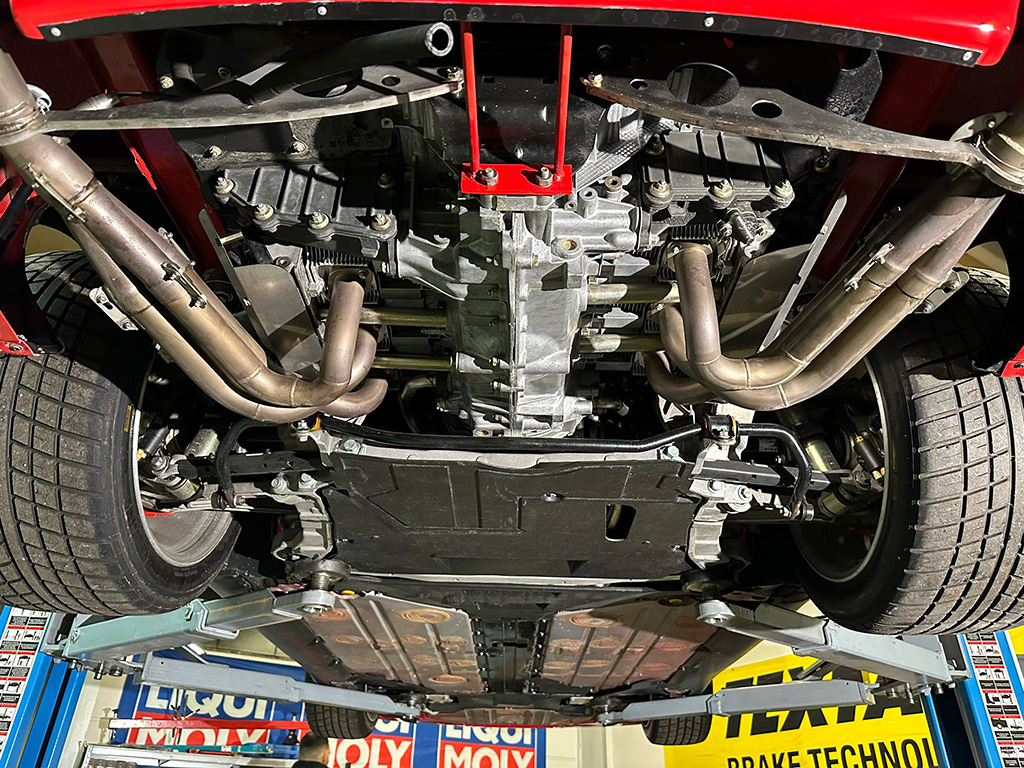
The RSR’s 3.8-liter M64/75 was a naturally aspirated, air-cooled flat-six producing approximately 349 horsepower. Yet focusing solely on the horsepower figure misses the engineering significance.
Porsche Motorsport fitted stronger and lighter valve gear, high-lift camshafts, special pistons and cylinders, revised intake and exhaust systems and six individual throttle bodies.
The result was an engine designed to respond immediately to the driver’s right foot while enduring the sustained loads of competition.
There were no layers of electronic intervention between driver and machine. Throttle position, engine speed, gear selection, braking and weight transfer all had immediate consequences.
That directness is one reason these cars remain so compelling today.
A modern GT racing Porsche is unquestionably faster, safer and more technologically sophisticated. But the modern driver works with electronic systems that simply did not exist in the same form when the 993 RSR was developed.
The RSR belongs to a different world—one in which mechanical communication remained central to the driving experience.
That history gives particular relevance to cars that have survived without extensive reinvention.
RGB Motors Reference #137 is a 1997 Porsche 911 Cup 3.8 RSR finished in Guards Red, with approximately 13,308 kilometres (8,269 miles) on the odometer.
Its ownership history is unusually limited for a competition Porsche: only three owners since new, with the current owner acquiring the car in 2017.
Unlike many RSRs that underwent repeated professional competition, accident repairs, drivetrain substitutions and continual updates, this example spent much of its life under collector stewardship. It was used in Porsche Club and NASA-related events rather than a full professional racing career.
That distinction is important.
A heavily raced RSR can have tremendous historical value when its competition history is significant and well documented. But a low-mileage, carefully preserved example offers something different: the opportunity to examine the engineering and specifications of the original Porsche Motorsport package without decades of racing evolution obscuring its character.
The car retains its matching-numbers configuration, as documented in the accompanying records, and has received specialist attention, including a Kelly-Moss inspection in 2016. Books, records, keys and supporting documentation accompany the car, with additional engineering and build information available.
For the collector, that documentation is an essential part of the automobile.
Owners of important historic racing Porsches face a difficult decision.
Should the car be preserved as an artefact, or should it continue to be driven as Porsche intended?
There is no universal answer.
Historic motorsport has shown that significant competition cars can be driven responsibly while still being carefully preserved. The key is preparation. Engine hours, gearbox condition, fuel-cell age, fire system, harness dates, suspension components and crack testing of critical parts all need to be considered before serious track use.
A collector primarily intending to display the car will evaluate it differently from someone planning to enter international historic events.
In either case, documentation should never be separated from the automobile. Original invoices, build records, technical sheets, photographs, inspection reports and ownership correspondence form the historical chain that future collectors will rely on.
Porsche was about to enter an entirely different technological era.
Water cooling, sophisticated electronics and increasingly complex GT racing platforms would transform the 911 competition car. The cars became faster and more capable, but something fundamental had changed.
The 993 Cup 3.8 RSR therefore holds a particularly important place in the Porsche story.
It represents the culmination of the naturally aspirated, air-cooled customer-racing 911: a machine built by Porsche Motorsport, drawing on decades of accumulated knowledge, and offered in extremely limited numbers to competitors who understood its intended purpose.
Approximately 45 examples were produced.
There will never be another generation of factory-built, air-cooled Porsche racing cars.
That simple fact gives the 993 RSR significance beyond horsepower, lap times or auction values.
It is a surviving piece of Porsche Motorsport history—a direct link to the era when the sound of an air-cooled flat-six at racing speed was inseparable from Porsche’s identity.
For collectors who value engineering history as much as rarity, that may ultimately be the most compelling reason to own one.
Ref N° 137 is available by appointment in Germany. Review the complete specification, provenance and gallery or speak directly with RGB Motors.

A one-off 1974 Porsche 911S RSR Turbo Evocation pairs up to 620 hp with a 1,050 kg chassis, specialist engineering and German road registration.

Factory provenance, scarcity and analogue usability explain why informed collectors are looking harder at Porsche Motorsport’s final air-cooled customer racer.
Founding philosophy
“I couldn’t find the sports car of my dreams, so I built it myself.”
Ferry Porsche
Founder of Porsche AG · 1909–1998