For three days each autumn, a quiet stretch of US 129 in the Great Smoky Mountains becomes the most concentrated gathering of Porsches in North America. The Rennsport Dragon Rally is not a Porsche-sponsored event — it has no official tie to Stuttgart — yet collectors fly in from Vancouver, Houston and Munich to be there.
The headline road, the Tail of the Dragon, is eleven miles of two-lane blacktop with three hundred and eighteen corners. There are no driveways, no cross-streets and very few places to get out of the way. The corners come at the rate of one every fifty-five metres for almost twenty minutes.
A weekend like this resets the calibration. Numbers on a spec sheet stop meaning anything when the road is this narrow.
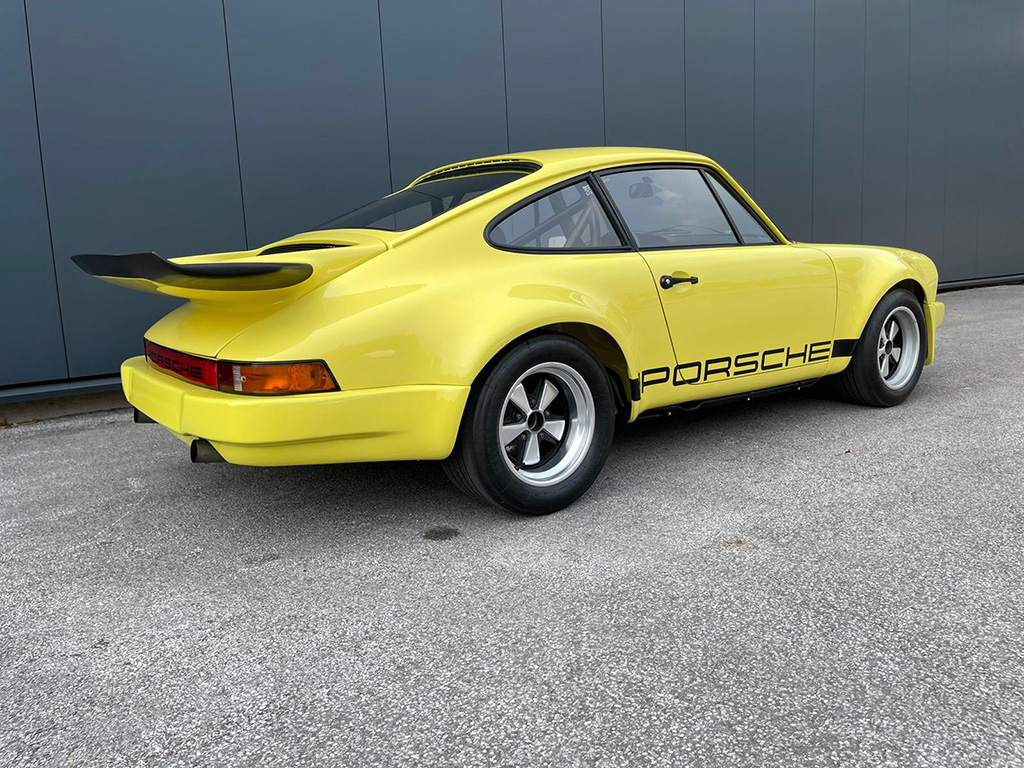
The 911S retains its original Fuchs five-spoke wheels and date-correct Pirelli tires.
My son Marvin and I drove a 1969 911S, the most modest car at the meet by a wide margin. The 911 was in its element here — patient with the road and unhurried with the steering. The Cayman GT4 ahead of us was visibly faster. The 2.7 RS three cars back was not.
The cars that win the day on a road like this are the ones the owner trusts — and the ones the owner does not mind throwing into a corner without thinking about resale. That filter eliminates a lot of cars in the modern market.
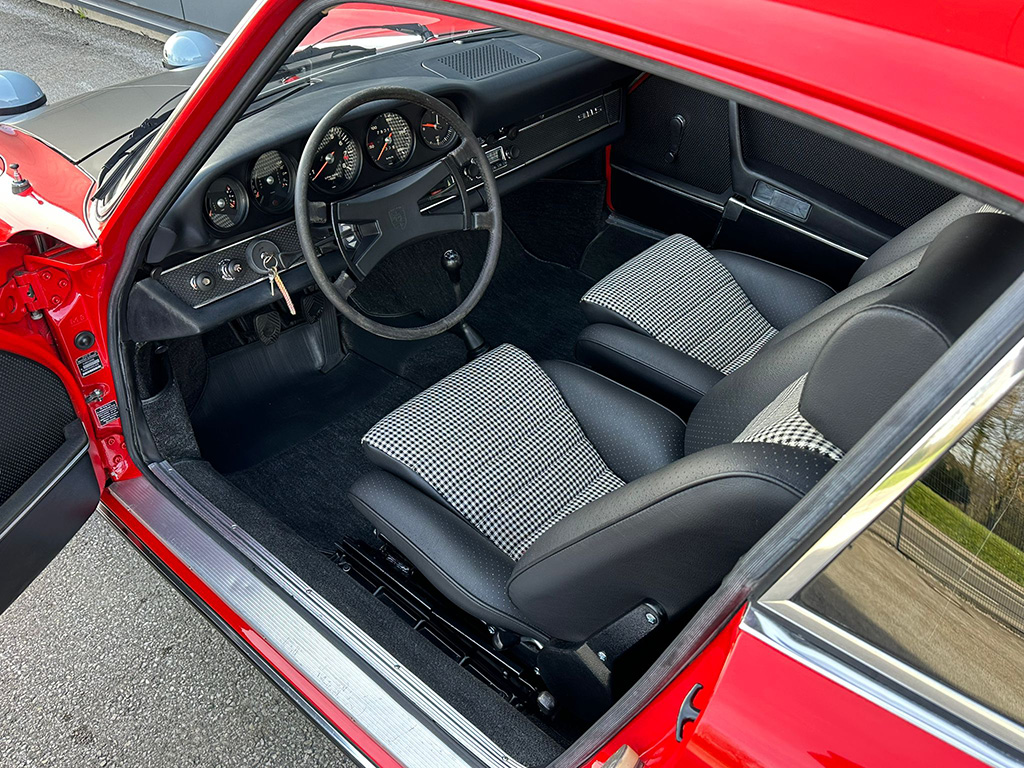
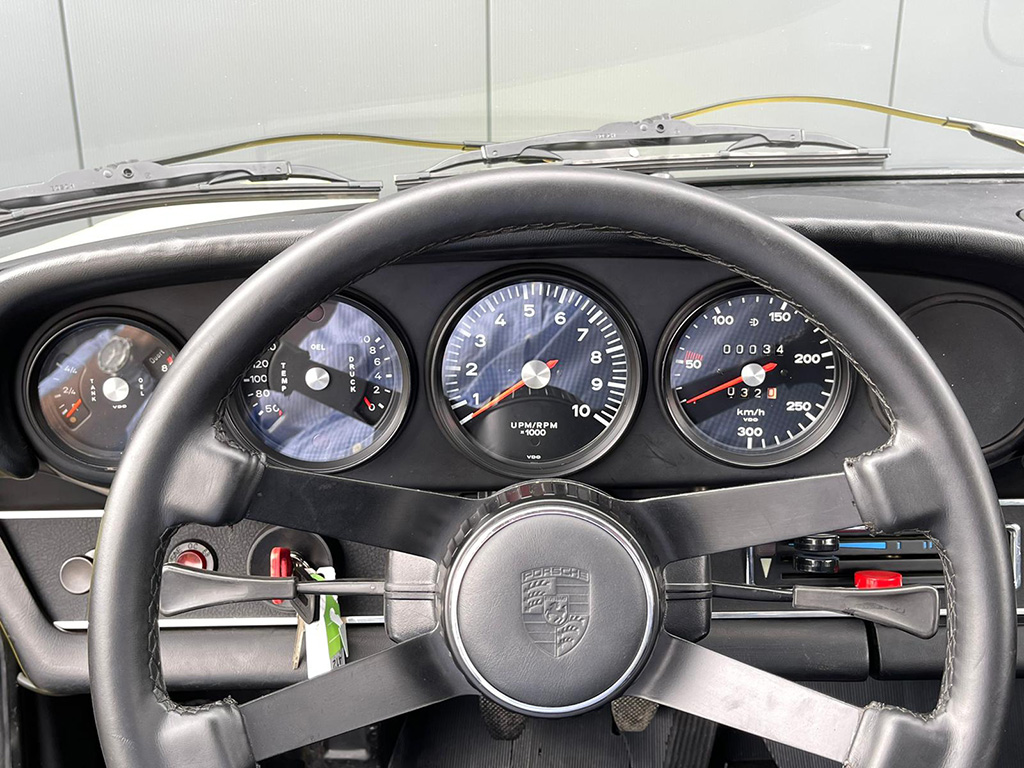
A perfect 911S cabin: tools, books, original radio. Nothing extra.
We will be back in 2027. The 911S will be back too. The list of cars I would rather drive on the Dragon, after this weekend, is short — and most of them live within a hundred miles of our studio.
A Lifelong Connection to the Nürburgring
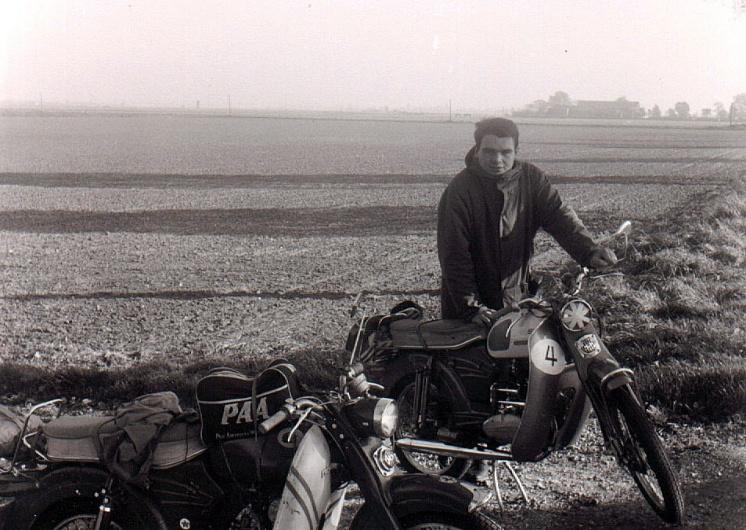
I grew up about 50 miles from the Nürburgring, near Cologne. In the mid-1960s, as teenagers, my friends and I would ride our small 50cc bikes out to the track for the weekend. We camped nearby, soaked in the atmosphere, and watched races on both Saturday and Sunday.
Ralf G. Bahr · on the way to the Nürburgring, late 1960s
The weather in the Eifel region, part of the Ardennes, was never predictable. Sudden rain showers were common, and more than once we ended up soaked. But none of that mattered. We were captivated by the sound, speed, and the incredible variety of racing machines, tackling what would later become legendary.
From Spectator to Driver
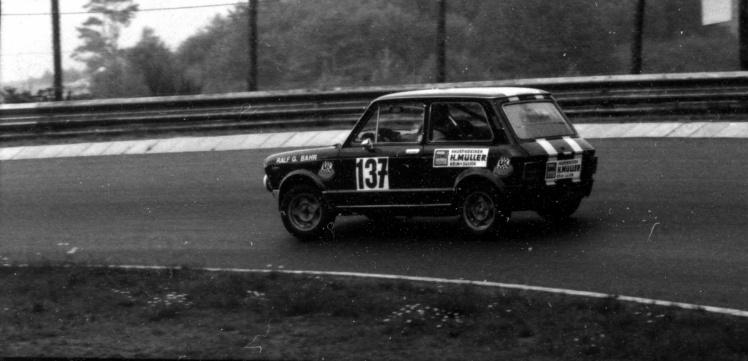
After completing my service in the Luftwaffe (German Air Force), I transitioned from spectator to participant. In my early twenties, I began modestly with a small souped-up Italian Autobianchi A112, but it wasn’t long before I progressed to more serious racing machinery:
Autobianchi A112 #137 · Ralf G. Bahr · Nordschleife
A Group 2 Ford Escort RS powered by a 2-liter Cosworth engine
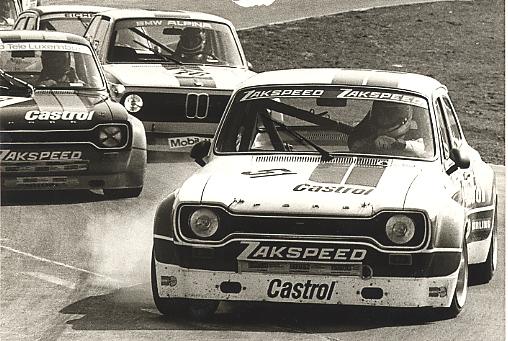
Later, a brief but unforgettable period racing in Group 2, a 3-liter Ford Capri RS
Group 2 racing · Ford Capri RS leading a BMW Alpina
In the early 1970s, my focus shifted primarily to endurance racing — 12-hour, 18-hour, and 24-hour events. These races required teams of at least three drivers, each taking roughly two-hour stints behind the wheel. Success demanded not only speed, but also physical endurance, concentration, and mechanical sympathy.
The classic Nordschleife itself was a relentless challenge — roughly 170 turns per lap and elevation changes of approximately 300 meters (1,000 feet), with the circuit reaching up to 620 meters (2,035 feet) above sea level. With manual gearboxes, no paddles, no electronics, and in a Group 2 car typically equipped with a 4- or 5-speed transmission, you were constantly at work, making an estimated 310 to 350 gear changes per lap. It was a true test of both driver and machine.
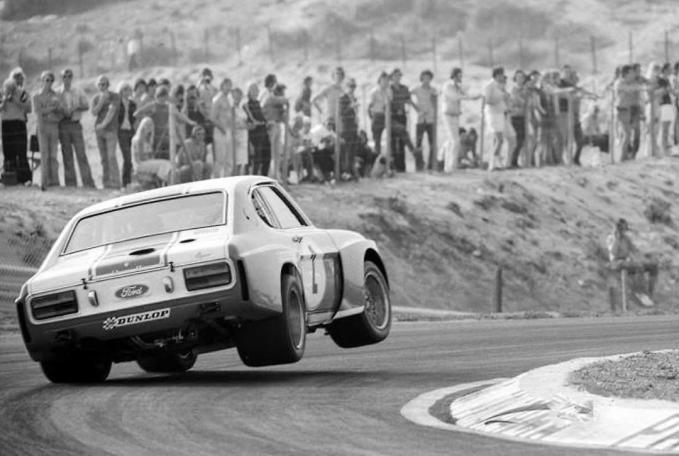
A Ford touring car at speed, Nordschleife · 1970s
There was something special about races like the Nürburgring 18 Hours. They weren’t just competitions; they were experiences that stayed with you long after the checkered flag.
The Nordschleife had its own rhythm. You would start in daylight, settle into your stint, and before you knew it, the light would begin to fade. Night would fall over the forest, and the track would change completely. Corners you thought you knew suddenly felt different. Visibility narrowed, focus sharpened, and every lap demanded respect.
And then there was the Eifel weather, never predictable, always part of the challenge. You could have clear conditions at the start and finish line, sitting at around 620 meters (2,035 feet) above sea level, yet just a few miles away, down in Hatzenbach, nearly 120 meters (400 feet) lower, you might suddenly encounter heavy fog or rain.
Communication was equally tough. Because of the terrain and the length of the track, contact between drivers and the pits was limited, mostly along the long straight near Döttinger Höhe and the start/finish area. Once you were on the lap, you were mostly on your own, relying on instinct, experience, and how the car felt.
Night driving introduced a whole new challenge. In the smaller Group 2 cars, lap times would reach around 12 minutes. Fatigue set in, visibility was reduced, and the track’s rhythm demanded even greater concentration. Each lap required patience, precision, and full focus.
Starting fields were large by today’s standards, often with close to or more than 120 cars taking the green flag. With such a mix of machinery and performance levels spread across the long Nordschleife, traffic was constant, and managing it became an essential part of endurance racing.
Traffic was steady and often intimidating. The speed difference between groups could be substantial. Slower cars were always at risk when professional racing teams approached at high speed, taking the optimal racing line. Often, little room is left, forcing smaller cars toward the edge of the track, sometimes even off it. It required alertness, quick judgment, and a lot of respect among drivers.
What made those races truly unforgettable was the atmosphere. It wasn’t just professionals; it was a mix of drivers, backgrounds, and ambitions. Touring cars, GT cars, and more specialized machines all shared the same narrow strip of asphalt. There was a strong sense of camaraderie, even among competitors.
It was raw, mechanical racing. No electronics, no safety nets, just the driver, the car, and the track. You listened to the engine, felt every movement, and managed the car for hours, not just laps.
Looking back, it was demanding, unpredictable, and at times exhausting — but above all, it was deeply rewarding. Those moments on the Nürburgring remain some of the most vivid and meaningful experiences of my racing years.
Like many of us, life eventually got in the way. A growing career, financial priorities, and family responsibilities caused me to step away from racing and shift to a more “civilized” form of motorsports enthusiasm. My love for the Nürburgring remained unchanged even after I immigrated to the USA in the early 80s. Almost every time I visit Germany, I must go to the Nürburgring and drive several laps, which brings back memories and makes my time there even more enjoyable.
Driving the Nürburgring Today
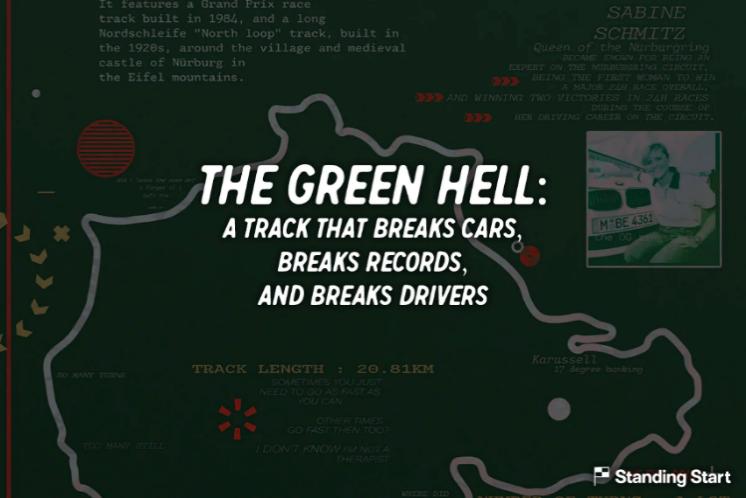
"The Green Hell" · Jackie Stewart's name has stuck for fifty years
Today, as a Tennessee resident and an active member of the local Porsche Club, I’m often asked about the Nürburgring. Many fellow members dream of visiting and even driving the legendary circuit on a trip to Germany. For those ready to turn that dream into reality, here is a practical guide to getting on track.
The Nürburgring, especially the Nordschleife, is one of the oldest, longest, and most challenging racetracks in the world. Jackie Stewart famously called it “The Green Hell,” a name that has endured ever since.
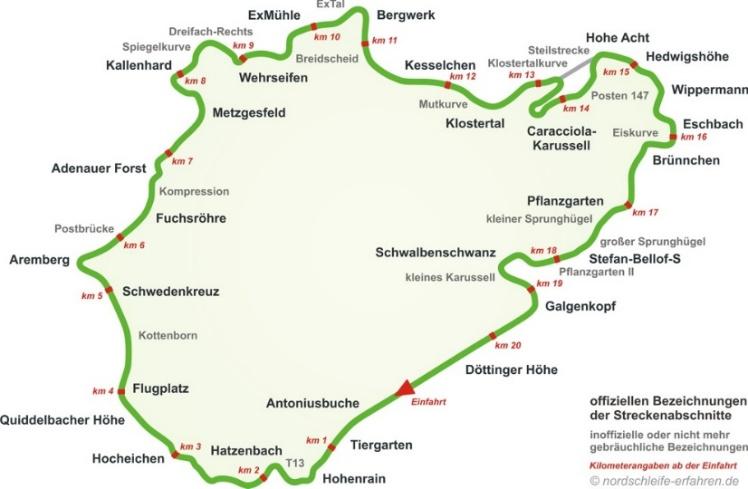
The Nordschleife · 20.8 km · official corner names · nordschleife-erfahren.de
Traveling to the Nürburgring
Fly into Cologne Bonn Airport (closest), Düsseldorf, or Frankfurt, and rent a vehicle.
Cologne Bonn Airport (CGN) — 101 km / 63 miles
Düsseldorf Airport (DUS) — 144 km / 89 miles
Frankfurt Airport (FRA) — 163 km / 101 miles
While trains are available, public transportation is inconvenient. Renting a car is strongly recommended. Best destination at the Ring: Nordschleife Parking — within walking distance of the entrance and Devil’s Diner.
When Can You Drive?
Touristenfahrten sessions occur at specific times:
Mainly on the Nordschleife
Occasionally on the Grand Prix circuit (GP)
Check:
Official Nürburgring calendar
Track status (closures due to accidents or cleanup)
Insurance — Read Carefully
Many visitors assume the Nürburgring is a public toll road and that they are fully insured. This isn’t entirely accurate.
Standard insurance does not cover Nürburgring driving
Damages to track barriers can be charged to the driver
Always verify coverage beforehand
Your Options at the Nürburgring
During Touristenfahrten (tourist driving sessions), you have several options:
Your own car
A specialized rental car (from companies insured specifically for Nürburgring driving)
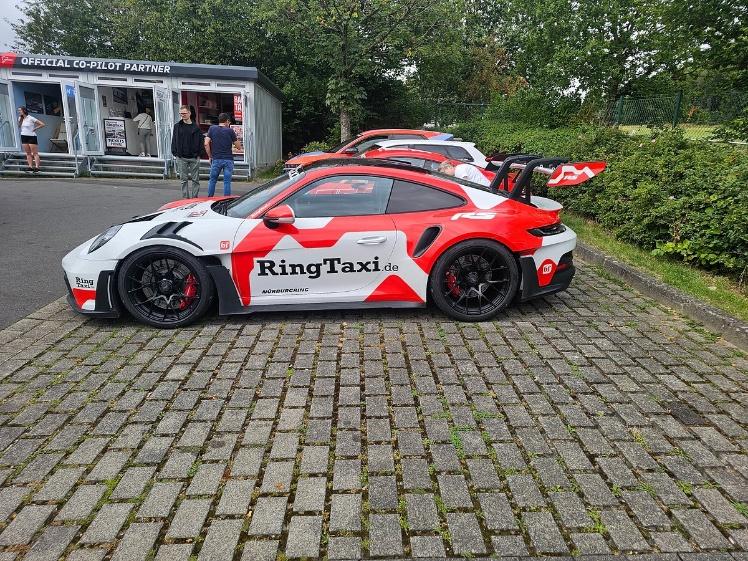
A passenger experience (Ring Taxi) — a high-speed lap with a professional driver
Porsche 911 GT3 RS · Ring Taxi · the Co-Pilot Partner kiosk at the Ring
Typical Ring Taxi experiences
Genesis Track Taxi — €70 per lap (~$77)
Porsche Cayman GT4 / GT3 — €299 per lap (~$330)
Porsche 911 GT3 RS — €649 per lap (~$715)
Expect about 30 minutes total experience, with approximately 10 minutes of actual lap time.
Tickets & Pricing
The Nürburgring uses a prepaid system called Green Hell Credits (GHC).
Typical pricing:
€30 per lap (Mon – Thu) — ~US $35
€35 per lap (Fri – Sun & holidays) — ~US $41
€35 for GP circuit sessions — ~US $41
You can purchase credits online or on-site.
Getting on Track
Enter via the Nordschleife entrance near Devil’s Diner
Scan your card at the barrier
No reservation required
And just like that, you’re on one of the most iconic tracks in the world.
Driving the “Green Hell” in a Porsche
Driving the Nürburgring is not like a track day. It operates under public road rules.
Insurance: Many policies exclude Nürburgring driving — verify in advance.
Respect the car: Even a Porsche can be challenged here.
Follow the rules: This is not racing. Pass left, stay alert.
Know your limits: The track is long, fast, and unforgiving.
Strict awareness of faster cars.
If you have an emergency while on the track, call +49 2691 302 9111.
Capture the moment
Photographers are stationed around the track, and you’ll likely find professional photos of your lap afterward. Friends and family can watch from various viewing points along the circuit.
Final Thoughts
The Nürburgring is more than just a racetrack to me; it’s a lifelong bond. From my early days on a 50cc bike, soaked in Eifel rain, to competing in endurance events, and now sharing stories with fellow Porsche enthusiasts here in Tennessee, it remains a place like no other.
Over all those years, one thing has remained constant: sports cars, and particularly Porsche drivers, belong at the Nürburgring.
Few experiences connect driver, machine, and history as powerfully as a lap of the Nordschleife.
Whether you are a Porsche enthusiast or simply a lover of performance driving — if you ever have the opportunity to experience the Nürburgring, take it. Drive it yourself or ride alongside a professional; the result is the same. The Nürburgring leaves a lasting impression.
Just remember to respect the track, know your limits, and enjoy every moment.
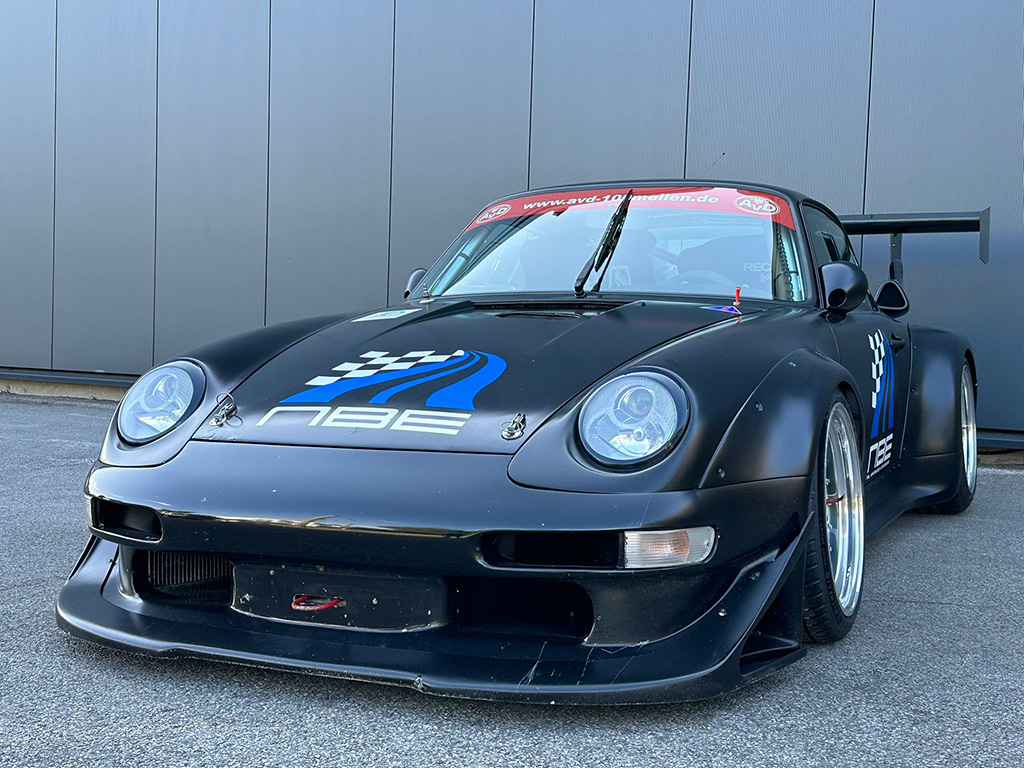
The 993 GT2 was conceived as a homologation special for GT1-class competition — a road car only because the rulebook required one. Porsche built fewer than 200 GT2 chassis between 1995 and 1998, and the racing variants are vanishingly rare. The Mamerow examples are rarer still.
Mamerow Racing was, for nearly two decades, one of the most consistent privateer teams in the German national championship. They campaigned a series of 993 GT2s with disciplined preparation, modest sponsorship and a quiet refusal to chase headline-grabbing results. The cars finished. The cars improved. The cars retained value.
Mamerow campaigned cars the way a marque historian writes — carefully, with footnotes, and no impulse to be loud.
The factory wide-body, with steel arches and louvred fenders — unchanged from new.
This chassis carries its original Mamerow livery, its FIA paper trail, and a service log that reads like a diary. Brake fluid intervals. Engine seal dates. The exact mileage at every track day for fourteen years.
It is not the fastest 993 GT2 in private hands. It is one of the most documented. For a collector who values the story as much as the lap time, this is a different proposition than the equivalent road car — and a more interesting one.
The cockpit — unrestored, original, and exactly as Mamerow last campaigned it.
The car is now offered through RGB Motors. Full dossier on request.
What We Look For in a 964 RSR
A 964 RSR is a hand-built car. The factory built roughly 55 examples between 1993 and 1995. Each one is documented from new, each one was sold to a privateer team, and each one has lived a life worth tracing before any conversation about value begins.
The history file
A 964 RSR without a history file is a different car. The original race log, the entry forms, the photographs from the campaign — these are not nice-to-haves. They are the difference between a car worth a serious sum and a car you would never recommend a client place a deposit on. The first question we ask is always: where is the binder?
A car is worth what its paper trail says it is worth. The rest is conversation.
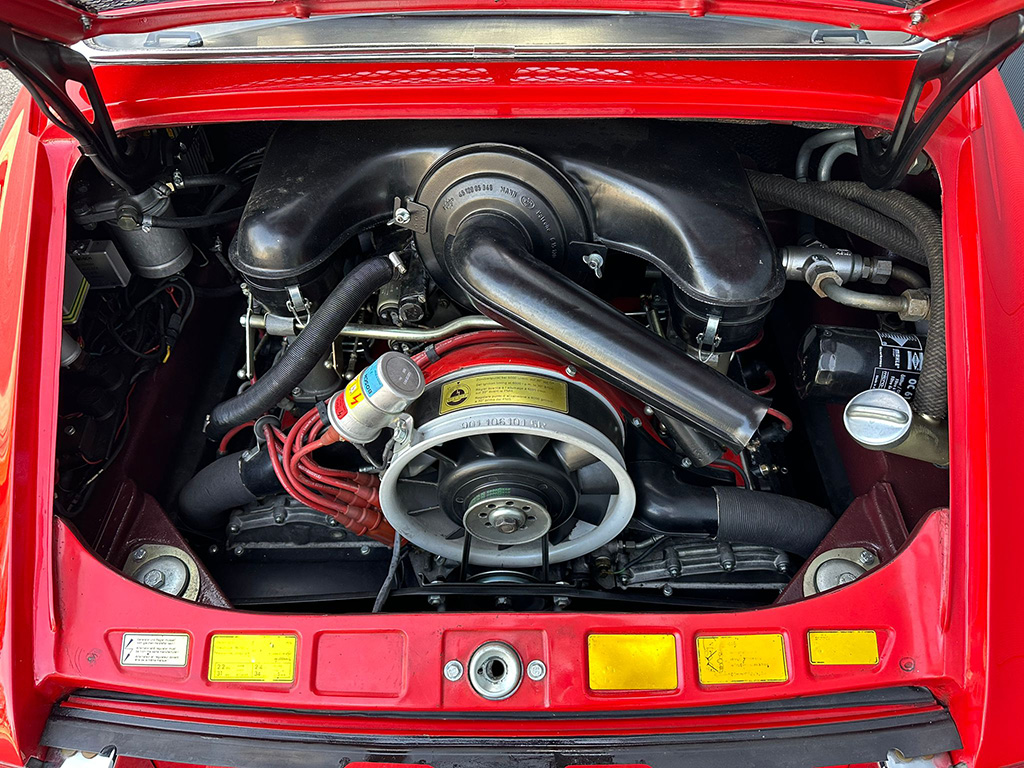
The twin-plug Mezger flat-six — the same architecture that defined the next decade of Porsche racing.
The mechanical
The Mezger 3.8 twin-plug is robust if it has been respected. We look for consistent service intervals, no temperature excursions, and a top-end refresh within the last 8,000 kilometres of competition use. A bottom-end out of the car for inspection is a yes. A bottom-end never out of the car since 1995 is a maybe.
Sequential gearbox: shift quality is everything. A car that misses gears under load is a quick rebuild away from sweet. A car that grinds is a hard pass.
A correct RSR cabin — stripped, caged, and free of the period add-ons that hurt value.
The chassis
A 964 RSR that has never been hit is a unicorn. Most have been touched somewhere. What matters is the quality of the repair, the documentation around it, and the consequence on chassis straightness. A pull-back-to-spec on a registered chassis log is a different conversation than a quiet weld.
We have appraised every 964 RSR currently in active circulation in Europe and North America. We are happy to share comparable notes with serious buyers, in writing, under NDA.
A Field Note from the 993 Cup Paddock
There is something restorative about a paddock that runs on coffee, gasoline and unbroken sentences. The 993 Cup grid at Spa this past March was a museum-grade gathering of the last single-make race cars Porsche ever built around the air-cooled flat-six. Twenty-eight cars on track. None of them out of place.
A 993 Cup carries its racing decals like a CV — each one a chapter.
I spoke to three drivers across the weekend. The first was racing his father’s car — same chassis, same sponsor decals, same engine number since 1998. The second was a new owner, two seasons into a planned five-year campaign. The third had been at it for fifteen years and could remember every car on the grid by colour.
The 993 Cup is the last race car Porsche made that an enthusiastic privateer can still run on a normal budget.
That is the through-line. The Cup cars are old, but they are not yet expensive in the way the road-going 993s have become. They are reliable. They are well-supported. They are usable. The same cannot be said for the 996 Cup that replaced them — yet — and that asymmetry is interesting.
The grid at Spa — twenty-eight Cup cars, each with two decades of history.
A 993 Cup is, for the moment, one of the most usable historic Porsches in circulation. We have one in inventory. If you would like to drive it before deciding, please let us know.
The 3.0 RS, Honestly
The 1973 Carrera 3.0 RS is one of the most coveted Porsches in the world. It is also one of the most routinely confused with its lighter, smaller sibling, the 2.7 RS. The two cars are related, but they are not the same proposition — and the market is finally beginning to treat them differently.
What it is
For 1974, Porsche enlarged the Carrera RS engine to 3.0 litres and stiffened the chassis around it. The result was a homologation special with twice the wing area, half the door panel and an extra 800 rpm of usable range. 109 road cars left Zuffenhausen. Most went directly to privateer racing teams. Some never left the showroom.
The 3.0-litre flat-six — 230 horsepower, twin-plug ignition, and a dry sump pressed into a road car.
What to look for
Originality of the engine is non-negotiable. Many 3.0 RS chassis were re-engined during their racing lives, which is part of their history but a different value proposition. A matching-numbers car — confirmed by Porsche Certificate of Authenticity — commands a clear premium. We have inspected cars at every point on this spectrum.
The bodyshell is the other story. RS-spec lightweight body, factory steel arches, original glass: these are the markers that separate a serious car from a competent restoration. We use a paint depth gauge before we use our eyes.
A 3.0 RS is judged on three things: its engine number, its bodyshell, and its history. Everything else can be fixed.
Internal RGB Motors appraisal guide
Inside: the correct lightweight door pull, the dated dash, the original three-spoke wheel.
What it is worth
The market for the 3.0 RS has moved decisively in the last 36 months. The strongest results are reserved for matching-numbers, documented, road-spec examples. Race-history cars have a separate, parallel curve that has appreciated more slowly but more steadily. A car offered without a Certificate of Authenticity will trade at a meaningful discount in either market.
We are currently offering a documented example through private placement. The dossier is available to qualified buyers on request.
Founding philosophy
“I couldn’t find the sports car of my dreams, so I built it myself.”